
Fenceline emissions detection refers to the use of sensors and monitoring technologies installed along the boundary of an industrial site to measure, track and assess air pollutants that may escape into surrounding communities.
Despite its importance, true fenceline monitoring remains widely misunderstood—or inadequately addressed—by parts of the gas monitoring and air-quality sector. In some cases, this misunderstanding also extends to institutions and regulatory bodies.
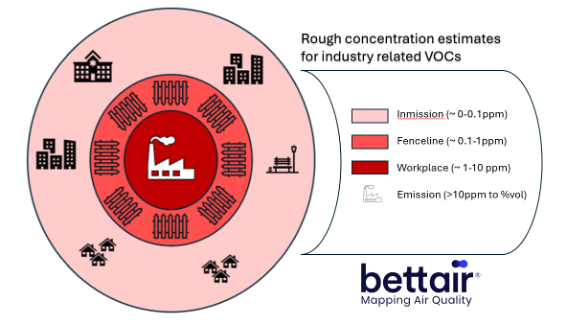
The impact of industrial emissions can generally be divided into four clearly differentiated zones:
- Emission – As close as possible to the emitting source
- Workplace – Inside the industrial premises where workers are present
- Fenceline – At the perimeter of the industrial installation
- Inmission – At nearby population centers
Each of these zones involves distinct technical challenges. Attempting to cover all of them with the same measurement strategy is fundamentally flawed.
Very different concentration ranges
At the emission source, gas concentrations often reach percentage levels by volume. Typical ranges may lie between 0.01% and 5% v/v—or even higher—which corresponds to approximately 1,000 to 50,000 ppm or more. In workplace environments, occupational safety regulations usually define acceptable exposure limits in the range of 1 to 500 ppm, depending on the compound.
At the fenceline, although specific regulatory thresholds are often absent, expected concentrations under normal operating conditions typically fall between 0.001 and 0.5 ppm (1–500 ppb).
For inmission—where emissions impact nearby residential areas—concentration levels are even lower, generally ranging from 0.0005 to 0.1 ppm (0.5–100 ppb).
The implication is clear: no single instrument can accurately and reliably operate across these vastly different orders of magnitude. Each zone requires purpose-designed technology and dedicated measurement strategies.
Bettair’s focus on precision where it matters
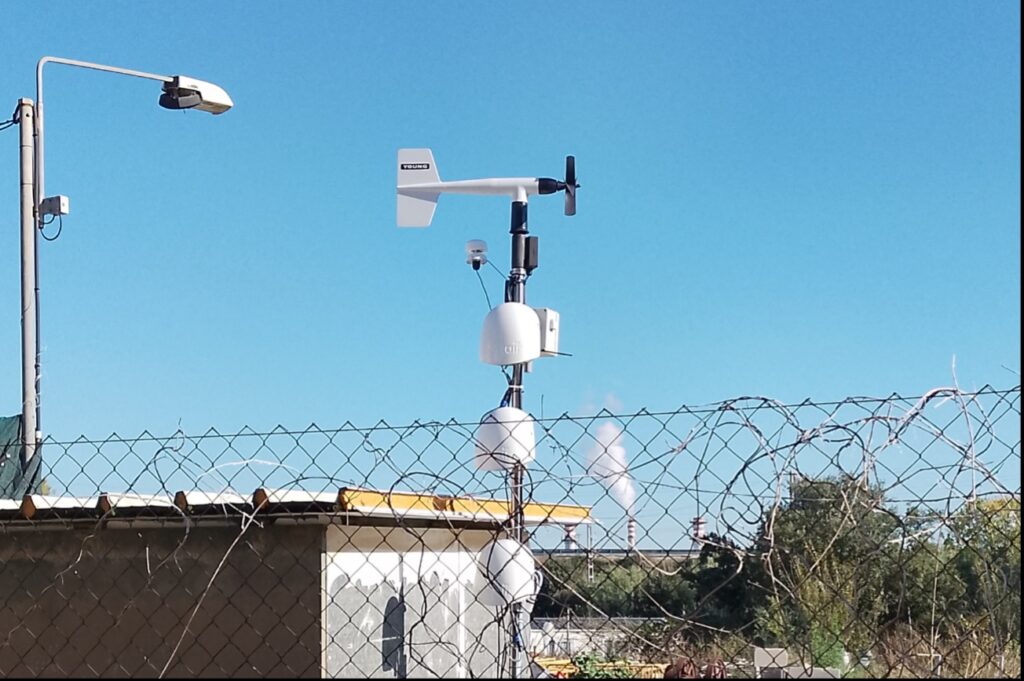
Bettair is a world specialist in inmission monitoring, supporting smart cities with high-precision air-quality data. At the same time, we have invested heavily in the development of true fenceline monitoring solutions for industries such as landfills and wastewater treatment plants (WWTPs).
These facilities are frequently associated with nuisance emissions affecting nearby communities. They also represent a significant technical challenge for conventional monitoring systems, which are typically designed for stack emissions or occupational safety applications.
The precision required for fenceline and inmission monitoring demands:
- Carefully designed hardware
- Robust compensation of environmental confounding factors
These are two areas in which Bettair has consistently excelled over recent years.
The case of Can Mata landfill in Catalonia
The Can Mata landfill, located in Hostalets de Pierola (Barcelona province), is one of the largest waste management facilities in Catalonia, covering approximately 28 hectares. It receives around 400,000 tonnes per year of the organic fraction of municipal solid waste from the Barcelona metropolitan area, northern Baix Llobregat and southern Anoia.
As in many large-scale landfills treating organic waste, the primary environmental concern is not point-source stack emissions but diffuse emissions—particularly odor episodes that may affect nearby residential areas depending on meteorological conditions.
To address this challenge, Bettair deployed a network of five air-quality monitoring nodes in two phases. The first phase focused on identifying and characterizing potential odor sources within the operational area. The second phase extended monitoring to the facility perimeter, enabling continuous fenceline assessment and evaluation of potential off-site impact.
The nodes continuously measured key odor-related compounds, including NH₃, H₂S, SO₂ and VOCs. The deployment was carried out in collaboration with NasApp, a technological platform specialized in odor episode management through the integration of citizen reports, sensor data and artificial intelligence.
By correlating real-time environmental measurements with geolocated citizen complaints, it became possible to better understand the origin, intensity and frequency of nuisance events, supporting more effective and data-driven mitigation strategies.
Proven accuracy, independently recognized
Bettair’s commitment to high-accuracy air-quality monitoring has been recognized through multiple awards at the Airparif Airlab Microsensors Challenge, including the 2021 and 2023 editions.
These recognitions underscore our ability to deliver reliable data where industrial emissions have the greatest social and environmental relevance: at the facility perimeter and in the areas where people live.
Bettair is committed to advancing air-quality protection through robust, reliable and purpose-built monitoring solutions.
Bettair Cities — precision that matters.